 5 min read

A vehicle fire is unusual among fire risks, because the people in danger are sitting inside the thing that is burning, and the fire almost always starts somewhere they cannot see. That combination is the whole argument for fire safety devices in vehicles. It is not that vehicles burn more readily than buildings. It is that the warning arrives late, the occupants are enclosed, and the response has to happen in the first minute or two.
Where vehicle fires actually start
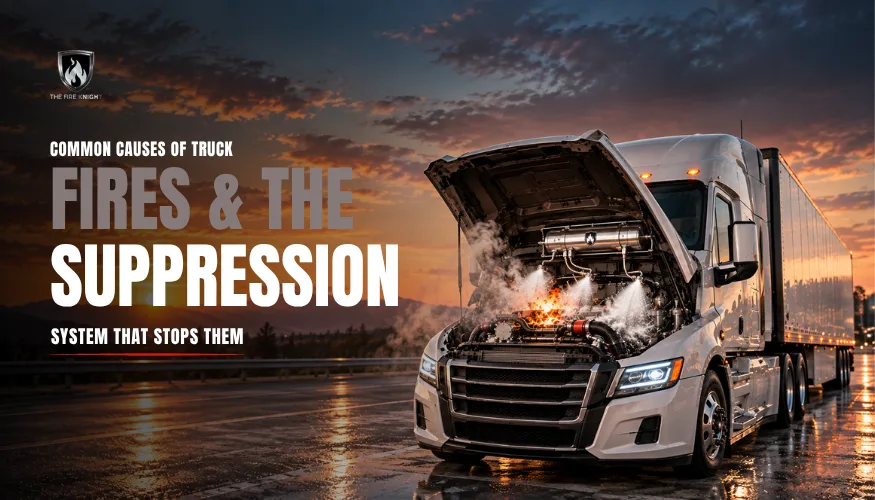
Very few begin in the cabin. The common origins are the engine bay, wiring looms and connectors, hydraulic lines on plant and heavy equipment, hot surfaces around exhausts and brakes, and battery compartments. All of them sit behind panels. The driver’s first indication is usually smell, smoke at the vents or a warning light, by which point the fire has been developing for some time in an enclosed space full of fuel, oil and plastics.
Timing compounds it. A fault that begins under load can surface after the vehicle is parked, so the fire develops in a yard, a garage or a depot with nobody nearby, and spreads to whatever is parked alongside. Fleets tend to discover this the expensive way, losing several assets rather than one.
This is a recognised engineering problem rather than a marketing one. ISO 19353 sets out fire prevention and fire protection for machinery, and its European adoption is published as BS EN ISO 19353. Both treat detection and suppression at the hazard as design considerations, not accessories.
Why a hand extinguisher is the wrong primary answer
A carried extinguisher assumes a sequence: the driver notices, stops somewhere safe, gets out, finds the extinguisher, reaches the fire and aims it accurately. On a motorway, at night, alone, or in a machine cab, several of those steps are difficult. Opening a bonnet to reach the seat of the fire also admits air to a compartment that was starved of it. Extinguishers still matter, and they need their own inspection and maintenance regime to be worth carrying, but they depend on a person being available and able to act.
A fitted system removes those dependencies. It watches the compartment continuously, and it acts at the source whether the vehicle is moving, parked or unattended.
Electric and hybrid vehicles change the problem
Lithium-ion batteries fail differently. The Fire Safety Research Institute describes how cells can overheat, catch fire and cause explosions through thermal runaway, a self-sustaining reaction that also releases flammable gas. Battery safety requirements for electric power train vehicles are addressed internationally through UN Regulation No. 100.
Honesty matters here. No suppression aid extinguishes a battery pack in thermal runaway. What early intervention can do is cool the surrounding area, slow fire spread to the rest of the vehicle, and give occupants and responders time. Any supplier claiming to put out a battery fire outright is overstating what the physics allows.
The response order still matters
A fitted system does not change what people should do. Stop where it is safe, get everyone out and well clear, and call the emergency services. Do not open a bonnet or an engine cover to inspect a suspected fire. What automatic detection and suppression change is the amount of time available to complete those steps, which is precisely how fire safety engineering frames protection: measures are chosen against defined objectives, and buying evacuation time is a legitimate objective in its own right.
Matching protection to the vehicle
| Vehicle or asset | Typical origin of fire | System |
|---|---|---|
| Passenger vehicles, EVs, buses and commercial trucks | Engine bay, wiring, battery compartments | The Sentinel |
| Mining equipment, haul trucks, excavators and generators | Hydraulics, hot surfaces and electrical faults on large plant | The Ranger |
| Battery enclosures, electrical cabinets and recreational vehicles | Compact enclosed spaces where a fault develops unseen | The Comodo |
What to look for in a vehicle fire system
- Detection suited to the environment: infrared flame and rate of rise heat sensing for engine bays, or linear heat detection cable routed along a machine so coverage follows the whole hazard rather than one point.
- Zoned coverage: the ability to discharge into the zone that is burning, rather than everywhere at once.
- Environmental protection: sealed electronics that survive vibration, dust, washing and temperature swings.
- Independent power: battery backup, because a fire that starts with an electrical fault may take the vehicle supply with it.
- Alerting that suits a fleet: notification by app, SMS or email, and an interface that reports into fleet systems rather than only sounding locally.
The Fire Knight systems are fire suppression aids and are not classified as fire extinguishers. They act early to limit fire growth and buy time, alongside statutory equipment, driver training and emergency services.
Frequently asked questions
1. Do fitted systems work when the vehicle is parked and switched off?
They should. Battery backup is what keeps detection live when the ignition is off, which matters because many vehicle fires are discovered after parking rather than during driving.
2. Does a fitted system replace the extinguisher we already carry?
No. Where an extinguisher is required by law or by an operator’s rules, it stays. A fitted aid covers the compartment you cannot reach, which fits the wider layered protection approach.
3. What upkeep does a vehicle system need?
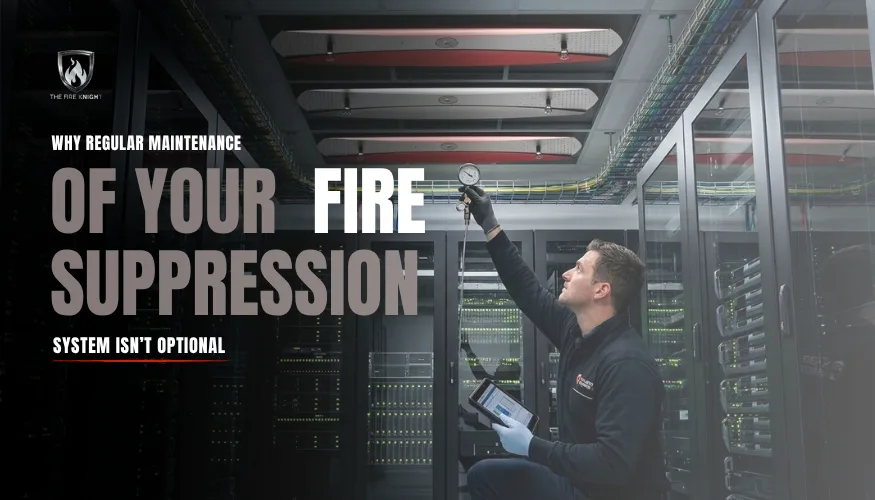
Pressure, nozzles, detection routing and mountings all need scheduled checks, particularly on machines that vibrate. Treat regular maintenance as part of the installation, not an afterthought.
Start with the compartments nobody can see
List the enclosed spaces on each vehicle or machine, and ask what would happen if a fire started in one at three in the morning in a yard. Explore The Fire Knight systems or speak with our team about your fleet.