 5 min read
There is no single best fire suppression system for storage. A sprinkler design that protects cartoned clothing can fail on plastic toys stacked higher. A heated-warehouse system will freeze in a cold store. Water that saves a building can destroy an archive.
The right choice matches the technology to what you store, how high you store it, how cold the space is, and how much water damage you can accept.
Start with the hazard, not the hardware
Fire engineers begin with the commodity. Codes such as NFPA 13 in North America and BS EN 12845 in the UK and Europe class stored goods by how fiercely they burn. Cartoned metal parts sit at the low end; expanded plastics, tyres, aerosols and flammable liquids at the high end.
Then comes the storage arrangement. Racks, piles and shelving burn differently, and every extra metre of height changes the water needed.
Storage fire suppression technologies compared
| Technology | Best suited to | Why it works | Watch out for |
|---|---|---|---|
| Wet-pipe sprinklers (control mode) | Most heated warehouses with ordinary goods | Simple, reliable, water on the fire fast | Design must match commodity and height |
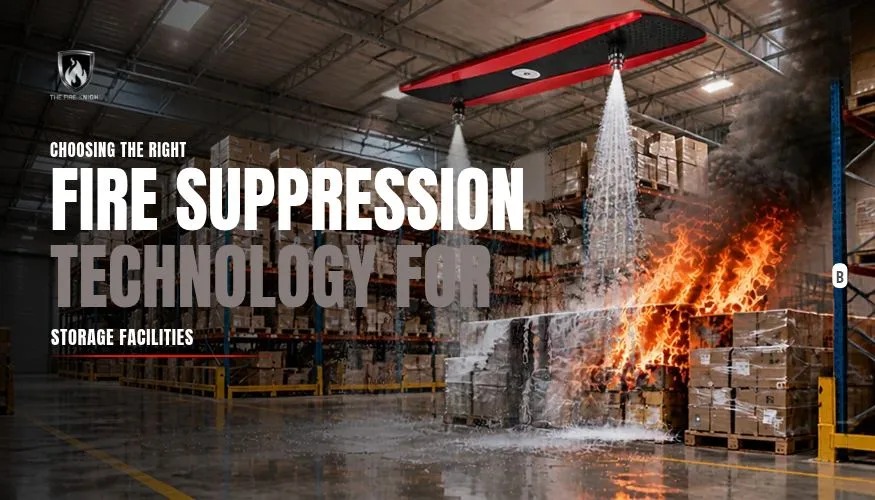
| ESFR sprinklers | Tall rack and pallet storage in heated buildings | High flow suppresses fire at ceiling level, often without in-rack sprinklers | Wet-pipe only; strict limits on height and obstructions |
| In-rack sprinklers | Very tall racks and high-hazard goods | Puts water inside the rack where the fire grows | Damage from forklifts; layout changes |
| Dry-pipe and preaction | Freezers, cold stores, unheated buildings | Pipes hold air, not water, until the system operates | Slower water delivery; more maintenance |
| Clean agent and inert gas | Records rooms, archives, IT and high-value stock | No water damage; no residue | Needs a sealed room; not practical for large open warehouses |
| Foam-water | Flammable and combustible liquids | Smothers burning liquid surfaces | Specialist design to NFPA 30 or equivalent |
| Water mist | Water-sensitive spaces | Fine droplets cool with less water | Must be tested for the specific hazard |
In the US, NFPA 13 generally allows ESFR sprinklers to protect storage up to about 12.2 m (40 ft) under a ceiling of about 13.7 m (45 ft). Above that, or with certain plastics, in-rack protection or a specialist design is usually needed.
The special case: lithium-ion batteries
Battery storage is now one of the hardest decisions. NFPA 13 does not yet give a full prescriptive protection scheme for lithium-ion batteries, so designers often rely on insurer guidance such as FM Data Sheet 7-112, along with the International Fire Code and NFPA 855, Chapter 14.
No suppression aid extinguishes a battery in thermal runaway. Early cooling can slow spread and buy time, but cells can reignite, so engineered protection and professional emergency response are essential.
Five questions to ask before you choose
- What exactly is stored, and could that change next season?
- How high is the storage, and how high is the ceiling?
- Is the space heated, or could pipes freeze?
- Can the stock tolerate water, or would water cause more loss than fire?
- Is your water supply adequate for the flow the design needs?
What the rules say in the US, UK and Canada
| Country | Key code or standard | What it means for you |
|---|---|---|
| United States | International Fire Code Chapter 32; NFPA 13 (sprinklers), NFPA 2001 (clean agents), NFPA 30 (flammable liquids), NFPA 25 (maintenance); OSHA 29 CFR 1910 Subpart L | High-piled storage needs a permit and an engineered design approved by your fire official |
| United Kingdom | Regulatory Reform (Fire Safety) Order 2005 (England and Wales); Approved Document B (England); BS EN 12845 (sprinklers), BS EN 15004-1 (gaseous), BS 8489 (water mist) | The responsible person must assess fire risk; systems should be designed and maintained to the relevant British Standard |
| Canada | National Fire Code of Canada 2025 and National Building Code, adopted provincially, which reference NFPA sprinkler standards | Your provincial fire code sets indoor storage and sprinkler requirements |
In every market, the authority having jurisdiction (US), fire and rescue service and responsible person duties (UK), or provincial fire marshal and adopted code (Canada) decide what is mandatory.
Common mistakes
- Raising racks or adding plastics without reviewing the sprinkler design.
- Installing obstructions below ESFR sprinklers.
- Choosing gas suppression for a room that cannot hold its concentration.
Where The Fire Knight fits
Fixed systems protect the main storage. Surrounding spaces still benefit from early fire detection and a fast local response.
- The Protector for indoor storage areas, offices and stores.
- The Comodo for electrical rooms, server cabinets and generator enclosures.
- The Guardian for outdoor yards, pallet stacks and external plant.
These are fire suppression aids. They do not replace sprinklers, gaseous systems or any code-required protection, and they do not remove any legal obligation.
Get the right protection around your storage
Storage operators can contact The Fire Knight about the spaces fixed systems miss, or become a Fire Knight distributor. Browse our fire safety blog or visit the Fire Knight homepage.
Frequently asked questions
Standard storage sprinklers control a fire until crews arrive. ESFR sprinklers deliver more water to suppress it, within strict height and layout limits.
Rarely. Gaseous systems need an enclosed space that holds the agent, so they suit rooms and vaults rather than large open buildings.
Usually a dry-pipe or preaction system, because the pipes hold air instead of water until the system operates.