 5 min read
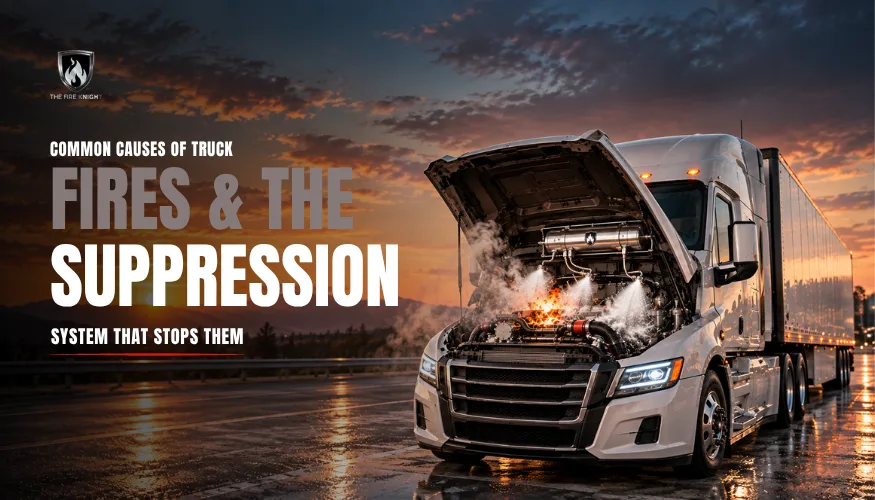
Most truck fires are not crash fires. They start when a part fails while the truck is working: a leaking fuel line, a chafed battery cable, a brake that will not release. The fire begins where the driver cannot see it, which is also why it can be caught early: failures that start in predictable places can be watched in those places.
How often trucks catch fire
In the United States, fire departments attended an estimated 15,462 large truck fires a year between 2018 and 2022, according to the NFPA vehicle fires report. Mechanical failure was the leading factor, involved in 44 percent, and large truck fires were more likely than other vehicle fires to start with a tyre.
In England, fire and rescue services attended 19,600 road vehicle fires in the year ending March 2026. The government’s detailed fire analysis puts the average response at 10 minutes 19 seconds, with only 58 percent reached within 10 minutes. Until then, the driver is the first responder.
The six most common causes of truck fires
- Fluid leaks onto hot surfaces: diesel, oil or hydraulic fluid spraying from a worn hose onto a turbocharger or exhaust manifold.
- Electrical faults: battery and starter cables rubbing through their insulation, overloaded aftermarket wiring and failing alternators. A short can smoulder before it flames.
- Wheel end heat: dragging brakes, seized bearings and underinflated tyres. Tyre fires are hard to put out by hand and can reignite.
- Exhaust and aftertreatment: debris or oily residue trapped against very hot exhaust parts and particulate filters.
- Cargo and trailer equipment: refrigeration unit engines, hot loads in refuse vehicles and dangerous goods.
- Collisions: impact can rupture fuel tanks and cut wiring at the same moment.
Battery electric trucks add a seventh risk: thermal runaway, where a damaged cell heats itself and releases flammable gas. No suppression aid extinguishes a battery pack in thermal runaway. Early detection and cooling can slow spread and buy time, but cells can reignite, so the fire service is always needed.
Match the protection to the zone
Each cause has a home on the vehicle, so sensors and nozzles go where fires start rather than across the whole truck.
| Zone | Typical ignition | Good protection |
|---|---|---|
| Engine bay | Fuel or oil on a turbocharger, electrical short | Flame and rate of rise heat sensing, nozzles aimed at hot surfaces |
| Battery box and cabling | Chafed cable, failed connection | Its own detection zone and an alert to the fleet office |
| Wheel ends | Hot brakes, seized bearing, tyre | Pre-trip checks and crews trained to keep clear |
What an automatic truck fire suppression system should do
A portable extinguisher depends on a driver noticing the fire, stopping safely and getting close to it. An automatic system removes those steps. Look for:
- Detection in the zone: infrared flame and rate of rise heat sensing respond to fire, not normal engine heat.
- Release without the driver: it works when the driver is resting or away from the truck.
- Connected alerts: the fleet office knows before the driver calls.
- Separate zones: a battery box fault should not empty the engine bay supply.
- Planned upkeep: vibration and washing are hard on any system, so regular fire suppression system maintenance matters.
For trucks, buses and fleets, The Sentinel uses infrared flame and rate of rise sensing across four zones, with IP67 electronics, 4G alerts by app, SMS and email, and an API for fleet systems. For mining trucks and heavy plant, The Ranger runs linear heat detection cable along the hazard and discharges through engineered nozzles. Both apply the principle behind early fire detection: the sooner a fire is found, the smaller it is.
What the rules require in the USA, UK and Canada
| Country | Key rule | What it means |
|---|---|---|
| United States | FMCSA 49 CFR 393.95 | A portable extinguisher rated at least 5 B:C, or 10 B:C for placarded hazardous materials. No fixed system required. |
| United Kingdom | Carriage of Dangerous Goods Regulations 2009 (Great Britain) | Dangerous goods vehicles carry extinguishers sized by vehicle weight under ADR. Otherwise, the operator’s risk assessment decides. |
| Canada | National Safety Code, run provincially | Each province sets equipment rules, for example Alberta’s commercial vehicle equipment regulation. |
These are minimums. Mining sites and some clients set stricter conditions, and your state, provincial or national regulator decides what is mandatory.
Protect the zones where your fires start
Check where your own fires and near misses have begun, then talk to our team about vehicle fire protection, see how fire suppression systems save lives and property or explore The Fire Knight range
Frequently asked questions
Mechanical failure, linked to 44 percent of US large truck fires, usually fluid leaking onto hot engine or exhaust parts.
Not for most road trucks in the USA, UK or Canada. Fixed systems are usually a risk based choice or a site condition.
No. Early detection and cooling can slow it and buy time, but professional emergency response is still required.