 5 min read
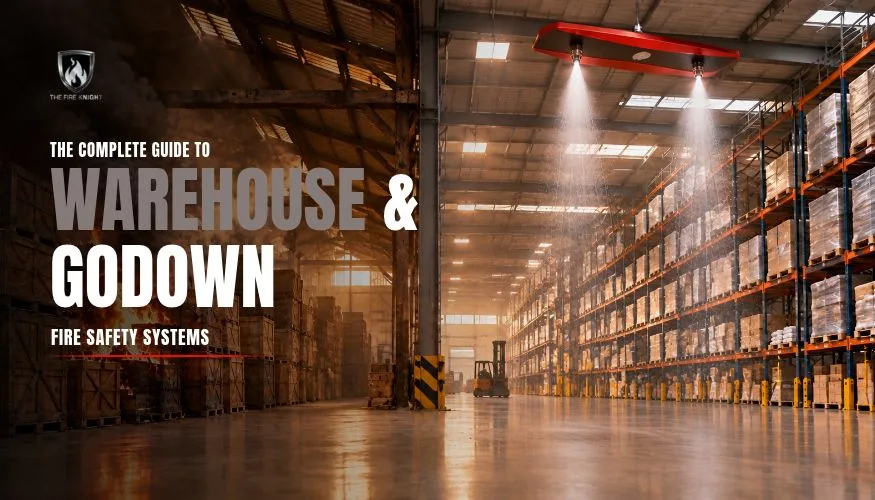
Whether you call it a warehouse, a distribution centre or a godown (the word used across much of Asia and the Middle East), the fire problem is the same. Large open floors, tall racking, cardboard, plastic wrap and pallets create a building that can burn faster than people can react.
Racking acts like a chimney. Flames climb the gaps between stacked goods, and a fire that reaches the upper levels soon outgrows an extinguisher or even a fire crew. The goal is simple: find the fire early and stop it before it climbs.
Why warehouse fires are so destructive
In the United States, NFPA estimates fire departments responded to an average of 1,508 warehouse structure fires a year from 2018 to 2022, causing about $323 million in direct property damage annually. Deaths are rare, but property and business losses are severe.
In England, insurer Zurich’s analysis of Home Office data found that of around 3,400 warehouse fires attended since 2010, half (49%) had no alarm and just 6% had sprinklers. That leaves many buildings relying on someone noticing a fire.
Common causes include electrical faults, forklift battery charging, hot work, poor housekeeping and arson around loading docks and pallet stacks.
Warehouse fire safety equipment checklist
| System | What it does | Key point |
|---|---|---|
| Automatic sprinklers | Controls or suppresses fire in racking | Design must match commodity, storage height and rack layout |
| Fire detection and alarm | Raises the alarm and alerts the fire service | Needs remote monitoring when the site is unoccupied |
| Portable extinguishers | First response by trained staff | Right type for each risk, kept visible and unobstructed |
| Fire-rated compartments and doors | Limit spread between storage, offices and plant | Never wedge fire doors open |
| Smoke venting | Releases heat and smoke from the roof | Helps crews see and slows structural damage |
| Emergency lighting and signage | Guides people out in darkness or smoke | Test on the schedule your code sets |
| Targeted suppression aids | Early local response in unwatched spaces | Electrical rooms, charging bays, yards |
Storage height changes everything
Codes treat tall storage differently. In the US, the International Fire Code (Chapter 32) classes combustible storage above 3.7 m (12 ft) as high-piled storage, or above 1.8 m (6 ft) for high-hazard goods such as Group A plastics and tyres. That triggers a permit and sprinkler design to NFPA 13.
The practical lesson applies everywhere: if you raise your racks, change your stock or add plastics, your existing sprinklers may no longer be adequate. Review the design before the change, not after a fire.
What the rules say in the US, UK and Canada
| Country | Key code or law | What it means for you |
|---|---|---|
| United States | International Fire Code Chapter 32 as adopted locally; NFPA 13 (sprinklers), NFPA 72 (alarms), NFPA 25 (maintenance); OSHA 29 CFR 1910 Subpart L | High-piled storage needs a permit and engineered sprinklers; employers must provide and maintain fire protection |
| United Kingdom | Regulatory Reform (Fire Safety) Order 2005 (England and Wales); Fire (Scotland) Act 2005; Approved Document B (England); BS 5839-1, BS EN 12845 | The responsible person must keep a suitable fire risk assessment; sprinkler guidance applies mainly to very large warehouses |
| Canada | National Fire Code of Canada 2025 and National Building Code, adopted provincially; CAN/ULC-S524 and S536 for alarms | Indoor storage rules and alarm testing are set by your provincial fire code |
In every market, the authority having jurisdiction (US), fire and rescue service and responsible person duties (UK), or provincial or territorial fire marshal and adopted code (Canada) decide what is mandatory for your building.
Maintenance tips that keep warehouse systems working
- Keep clearance below sprinklers. Stock stacked too close to sprinkler heads blocks the spray.
- Keep aisles and flue spaces open. The gaps in racking let sprinkler water reach the fire.
- Test alarms and monitoring on schedule, and confirm signals reach someone at night.
- Control charging areas. Keep forklift battery charging away from stock, and remember lithium-ion cells in thermal runaway can reignite, so engineered protection and professional response are essential.
- Manage the yard. Move pallets, waste and skips away from walls and loading doors.
- Use hot work permits with a fire watch afterwards.
Where The Fire Knight fits
Sprinklers protect the racking. The spaces around it often go unwatched, which is where early fire detection and a fast local response help most.
These are fire suppression aids. They do not replace sprinklers, alarms or any code-required system, and they do not remove any legal obligation. High-bay racking needs an engineered sprinkler design.
- The Protector for indoor warehouse areas, offices and stores.
- The Comodo for electrical rooms, server cabinets and generator enclosures.
- The Guardian for outdoor yards, pallet stacks and external plant.
- The Ranger for forklifts, yard tractors and mobile plant.
Protect your warehouse
Warehouse and logistics operators can contact The Fire Knight to plan detection and suppression aids around their racking. Find more guides on our fire safety blog and the Fire Knight homepage.
Frequently asked questions
A godown is a warehouse or storage depot, a term common in South and Southeast Asia and the Gulf. The same fire principles apply.
Not always. It depends on size, storage height, goods stored and local code. High-piled or high-hazard storage usually requires them.
Electrical faults, heating and charging equipment, hot work and arson are frequent causes. Good housekeeping removes much of the fuel.