 5 min read
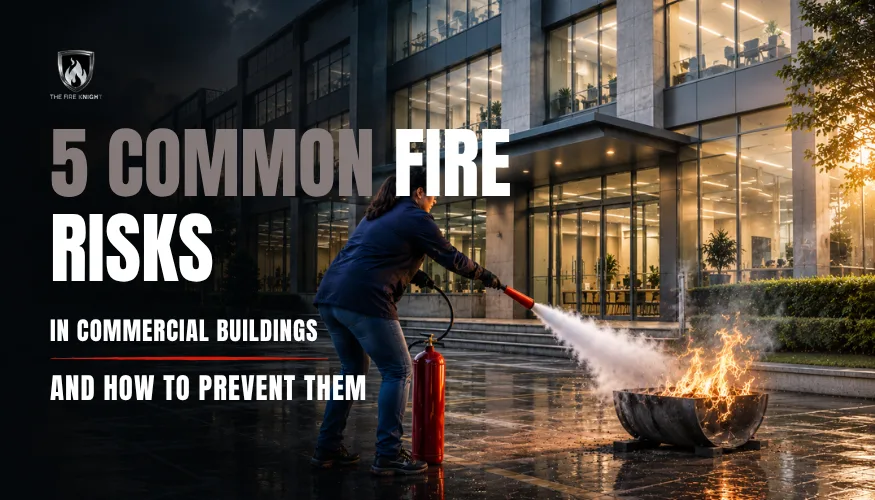
The five most common fire risks in commercial buildings are already known to the people who manage them. Electrical faults, plant, storage, kitchens and human error appear on every risk assessment. What separates a contained incident from a total loss is rarely the hazard. It is the time between ignition and an effective response, and in most commercial buildings nobody is watching it.
What the fire data shows about commercial buildings
In England alone, fire and rescue services attended 13,134 fires in buildings other than dwellings in the year ending March 2025, according to Home Office statistics. Electrical distribution was the largest specified source of ignition, at 16 per cent. The same dataset records an average total response time of nine minutes and three seconds. National datasets are collected differently and are not directly comparable, as the CTIF Centre of Fire Statistics cautions.
Nine minutes is a long time in a modern fire load. Experiments by the Fire Safety Research Institute, part of UL Research Institutes, compared identically furnished rooms and recorded flashover, the point at which every exposed surface ignites almost simultaneously, at three to five minutes with synthetic furnishings against more than twenty-nine minutes with natural materials.
Five Common Fire Risks in Commercial Buildings, and their Controls
- Electrical distribution and overloaded circuits: ageing switchgear, damaged flexible cables and circuits carrying more than they were designed for. The control is scheduled inspection and testing with a written record, not an annual visual walk round.
- Heating, ventilation and air conditioning plant: dust accumulation, bearing failure and motors running unattended overnight. Plant rooms and roof-mounted units are the least visited part of most buildings, so cleaning intervals and temperature monitoring matter.
- Flammable and combustible storage: solvents, aerosols, fuels, packaging and waste. Quantity, separation and ventilation decide the outcome. Keep stock in designated, labelled and ventilated areas away from ignition sources and escape routes, and treat waste accumulation as a hazard.
- Commercial kitchens: grease in extraction ductwork is the risk inspections miss, because it is out of sight and burns hot. Deep clean the full duct run rather than the visible canopy, at a frequency matched to cooking volume.
- Human factors and housekeeping: propped fire doors, blocked exits, hot work without a permit, chargers left running. Training changes behaviour only when it is specific to the site, so pair it with unannounced audits.
Three things are often confused. ISO 7240-14 gives international guidance on the design, installation, commissioning and service of detection and alarm systems in buildings. EN 54 is the European product and system series, adopted nationally, for example as BS EN 54-1 in the United Kingdom. National legislation sits above both and differs by country, so verify local duties before specifying.
Where prevention stops working
Every control above depends on someone being present, or on the fire starting in occupied hours. Fires do not respect that. A warehouse at three in the morning, an unstaffed plant room, a remote telecoms switchroom, a haul truck at the far end of a mine: detection may work perfectly and still produce only an alarm that nobody is standing next to.
This is the gap that early fire detection is meant to close, and it closes only when detection is connected to something that acts. The same shift is already visible in home and office fire protection.
Closing the gap between detection and response
The Fire Knight builds systems around three linked functions: detect with more than one sensing method to avoid unwanted alarms, alert named people immediately by app, SMS and email, and release a water based suppressant on the seat of the fire while the alarm is still travelling. The development is covered by International Patent Application No. PCT/AU2023/050224.
| Environment | Typical gap | Fire Knight system |
|---|---|---|
| Offices, retail, hotels, healthcare | Alarm sounds out of hours, nobody responds | The Protector |
| Server rooms, switchrooms, battery enclosures | Enclosed, high value, rarely visited | The Comodo |
| Fleets, buses, EVs, heavy machinery | Fire starts away from any building | The Sentinel |
| Mining plant, industrial machinery, generators | Vibration and heat, no operator present | The Ranger |
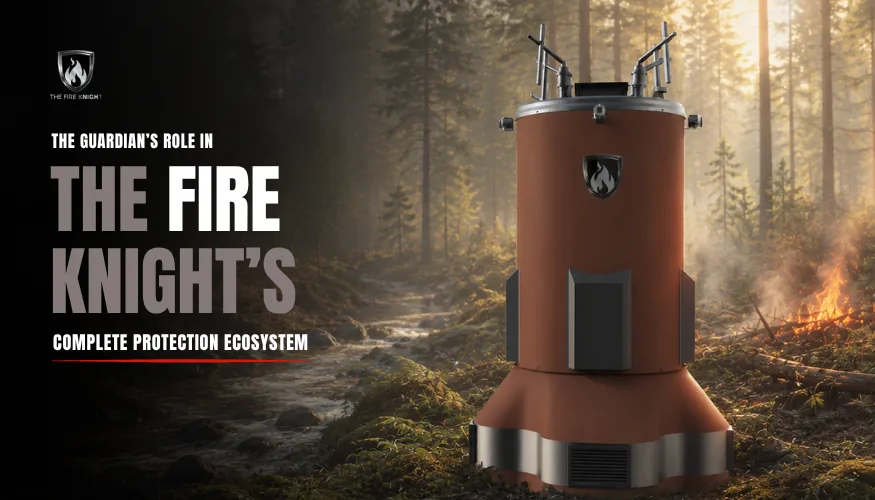
| Yards, substations, masts, plantations | No mains power, no staff on site | The Guardian |
The Fire Knight systems are fire suppression aids and are not classified as fire extinguishers. They sit alongside statutory detection, alarm and suppression provisions rather than replacing any of them.
A practical sequence
- Review the fire risk assessment across every area, including plant rooms and external stores.
- Fix the housekeeping and electrical findings first: they are cheap and remove ignition sources.
- Confirm detection coverage against ISO 7240-14 or the applicable national standard, and record the gaps.
- Route alerts to people who can act at any hour, not only to a panel.
- Add automatic response where the gap between alarm and arrival is longest.
- Rehearse the plan and re-test annually, treating maintenance records as evidence.
Frequently asked questions
Fire Safety Research Institute experiments recorded flashover in rooms furnished with synthetic materials at three to five minutes. Commercial interiors contain many of the same materials, so detection and response are judged in minutes.
No. The Fire Knight systems are fire suppression aids, not fire extinguishers, and they remove no statutory obligation. They add a response where a required system detects and warns but does not intervene.
It depends on jurisdiction. ISO 7240-14 provides international guidance, EN 54 governs products and systems across Europe, and ISO 23932-1 sets general principles for performance based fire safety engineering. National law determines what is mandatory.
Next steps
If your risk assessment shows areas where an alarm would sound with nobody there to act, review what an autonomous system would change. Explore The Fire Knight range, or speak to the team about your site.