 5 min read
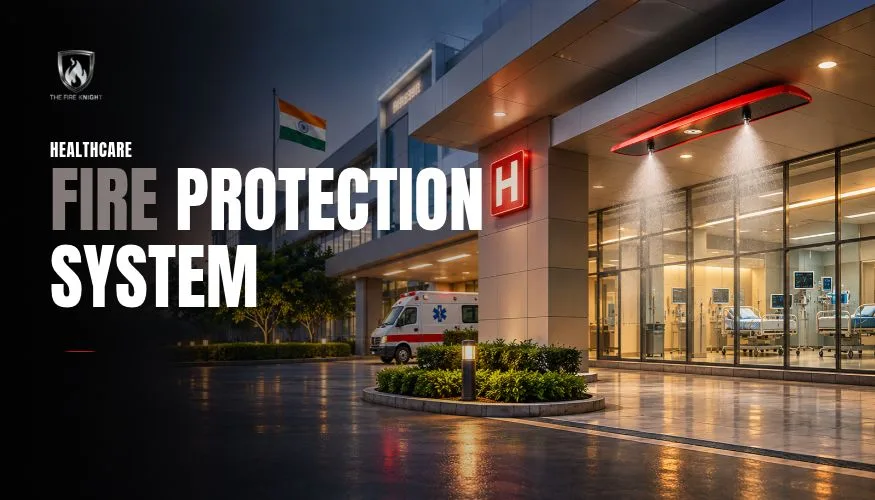
A fire in an office empties the building. A fire in a hospital usually cannot. Patients may be sedated, attached to ventilators, recovering from surgery or simply unable to walk, so healthcare buildings are designed to protect people where they are while staff move them away from danger in stages.
This is called defend in place in North America and progressive horizontal evacuation in UK practice. It only works if every fire protection system performs first time. Below: why healthcare is different, an equipment checklist, and the maintenance habits that keep it working.
Why fire protection matters more in healthcare
- Occupants who cannot escape alone. Evacuation depends on staff, who are fewest at night.
- Oxygen-enriched areas. Medical oxygen makes materials ignite more easily and burn more intensely.
- Round-the-clock fire loads. Kitchens, laundries and plant rooms never stop.
- Critical infrastructure. Losing a server room, generator or medical gas supply is a clinical emergency.
In the United States, NFPA estimates fire departments attended an average of 5,750 structure fires a year in healthcare facilities between 2011 and 2015, its most recent dedicated study. Cooking caused 65% of them, and only 4% spread beyond the room of origin.
In the UK, NHS Wales recorded 51 fire incidents and 1,529 unwanted fire signals across its estate in 2024, with electrical equipment failure the most common cause of fire.
Healthcare fire protection equipment checklist
| System | What it does | Where it matters most |
|---|---|---|
| Addressable fire detection and alarm | Finds fire early and pinpoints the zone | Every area, especially wards |
| Automatic sprinklers | Controls fire at its source | Whole building; required in new US health care occupancies |
| Fire doors and smoke compartments | Hold back fire and smoke while patients are moved | Wards, corridors, stair cores |
| Smoke control and fire dampers | Keep escape routes clear | Ducts crossing compartment walls |
| Portable extinguishers and fire blankets | First response by trained staff | Kitchens, nurse stations, plant rooms |
| Kitchen wet chemical system | Suppresses cooking oil fires | Kitchens |
| Emergency lighting and signage | Lights escape routes during power loss | Corridors, theatres, stairs |
| Medical gas zone valves | Isolate oxygen to one area | Outside wards and theatres |
| Targeted suppression aids | Early local response where fire starts unseen | Server rooms, generator enclosures, electrical cupboards |
What the rules say in the US, UK and Canada
| Country | Key code or law | What it means for you |
|---|---|---|
| United States | NFPA 101 Life Safety Code and NFPA 99 Health Care Facilities Code, enforced in their 2012 editions by CMS; NFPA 72 and NFPA 25 for testing | Medicare and Medicaid facilities are surveyed against these editions, not the newest ones |
| United Kingdom | Regulatory Reform (Fire Safety) Order 2005 in England and Wales; Fire (Scotland) Act 2005; NHS Firecode HTM 05-01, 05-02 and 05-03; BS 5839-1 for alarms | A responsible person must keep a suitable fire risk assessment |
| Canada | National Fire Code of Canada 2025, adopted provincially; CSA Z8000 for facility design; CAN/ULC-S536 for alarm testing | Hospitals are Group B occupancies under your provincial code |
In every market, the authority having jurisdiction (US), fire and rescue service and responsible person duties (UK), or provincial or territorial fire marshal (Canada) decide what is mandatory.
Maintenance tips that keep healthcare systems working
Fire systems decay quietly. A January 2024 NHS Wales fire alarm survey report in 92 inpatient facilities found about 25% of systems were considered obsolete, around 38% of detectors were outdated, and 66% of sites had not verified their cause and effect matrix. None of that shows on a normal day.
- Work to a written inspection, testing and maintenance schedule under NFPA 25 and 72, BS 5839-1 or CAN/ULC-S536, and keep records survey-ready.
- Test cause and effect, not just devices. Confirm an alarm releases door hold-opens, closes dampers and calls the fire service. As we explain in the future of home and office fire protection, the alarm is not the response.
- Treat false alarms as maintenance data. Repeat activations often mean contaminated detectors.
- Manage impairments. When a system is out of service, apply the interim measures your code requires, such as a fire watch.
- Keep fire doors working. Check closers and seals, and stop doors being wedged open.
- Train and drill every shift, including nights.
Where The Fire Knight fits in a healthcare fire strategy
Hospitals contain spaces nobody watches: comms rooms, generator enclosures, stores and ambulances. Here early fire detection and a local response add most.
- The Comodo for server rooms and generator enclosures.
- The Protector for indoor stores and offices.
- The Sentinel for ambulances and patient transport vehicles.
- The Guardian for outdoor plant and infrastructure.
These are fire suppression aids for support spaces. They do not replace sprinklers, alarms, compartmentalization or any code-required system, or remove any legal obligation.
Talk to us about your support spaces
Healthcare estates teams can contact The Fire Knight to discuss plant rooms, enclosures and vehicles, or browse our fire safety blog or visit The Fire Knight homepage.
Frequently asked questions
Typically detection and alarm, sprinklers, fire doors and compartments, extinguishers, emergency lighting and kitchen suppression. Your risk assessment and local code confirm the list.
The building protects patients where they are, using compartments that hold back fire and smoke, so staff can move people horizontally rather than downstairs.
Intervals are set by NFPA 72 in the US, BS 5839-1 in the UK and CAN/ULC-S536 in Canada. All combine routine tests with periodic competent servicing.