 5 min read
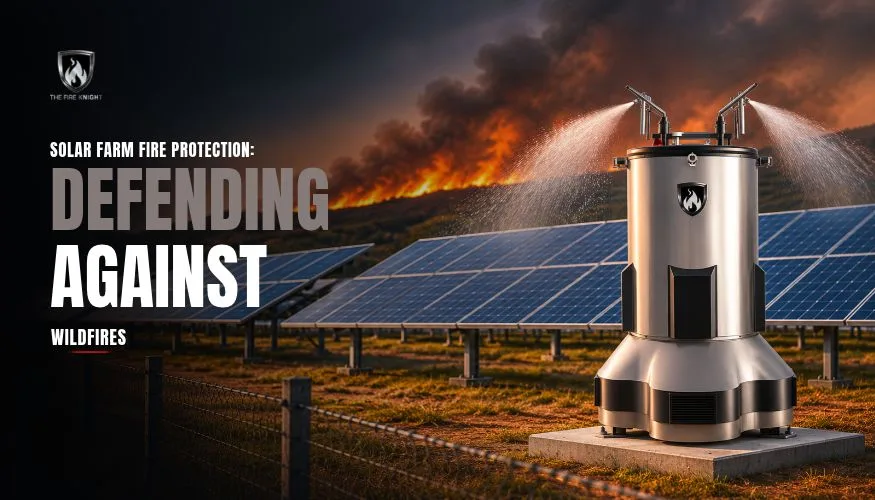
Most solar farms are built where land is cheap, open and sunny. That often means dry grassland, scrub or forest edge, a long drive from the nearest fire station, and nobody on site for most of the day.
So a solar farm fire often starts outside the fence and arrives when the site is empty. A good plan answers both: keep fuel away from equipment, and let the site detect and respond to fire on its own.
Why wildfire is now a solar farm risk in all three markets
- United States: NIFC recorded 77,850 wildland fires in 2025, burning about 2.1 million hectares (5.13 million acres).
- Canada: the Canadian Wildland Fire Information System recorded 6,127 fires in 2025 across 8.9 million hectares (about 22 million acres), the second-worst season on record.
- England: outdoor fires made up 64% of all fires attended in the year ending March 2026, after a hot, dry summer drove a sharp rise in grass and vegetation fires.
Solar farms add their own ignition sources: inverters, cable faults, substations and battery storage. A fire that starts on site can also become someone else’s wildfire.
How fire threatens a solar farm
| Threat | What happens | Main defence |
|---|---|---|
| Grass fire running into the arrays | Dry grass carries flame between rows | Vegetation control under and around arrays |
| Embers from a nearby wildfire | Wind carries embers into fuel and enclosures | Fuel-free perimeter, sealed enclosures |
| Electrical fault on site | Arcing or overheating in inverters or transformers | Maintenance, thermal imaging, detection |
| Battery energy storage fire | Thermal runaway produces heat and gas; cells can reignite | Engineered protection to NFPA 855 or NFCC guidance |
| Hot work and mowing machinery | Sparks or hot exhausts ignite dry grass | Permits, fire watch, equipped plant |
The core layers of solar farm fire protection
1. Vegetation management
This is the single most effective control. The International Fire Code (Section 1205 in recent editions) requires a clear, brush-free area of 3 m (10 ft) around ground-mounted photovoltaic arrays. Keep grass short under the panels too.
It works. In a 2026 wildfire in France, an 11 MW plant with cleared vegetation lost only around 100 of its 43,500 modules.
2. Access and water
Crews need all-weather roads, turning areas, clear gates and a known water supply. Agree these with your fire service at design stage.
3. Detection that reports itself
An unstaffed site cannot rely on someone smelling smoke. Early fire detection at inverter stations, substations and the perimeter, with remote alerts to the operator, can turn a lost site into a contained incident.
4. Local suppression at critical equipment
Inverter stations, control rooms and comms cabinets are where fires start unseen and losses are highest. Targeted protection buys time until crews arrive.
5. Engineered protection for battery storage
Battery storage needs its own design: spacing, explosion control, detection and an emergency plan. No suppression aid extinguishes a battery in thermal runaway. Early cooling can slow spread, but cells can reignite, so engineered systems and professional response remain essential.
What the rules say in the US, UK and Canada
| Country | Key code or guidance | What it means for you |
|---|---|---|
| United States | International Fire Code Section 1205 (ground-mounted PV) as adopted locally; NFPA 855 (2026 edition) for energy storage; NFPA 1140 for wildland fire protection | Brush-free clearance, fire access and a hazard mitigation analysis for battery storage |
| United Kingdom | Regulatory Reform (Fire Safety) Order 2005 (England and Wales); NFCC grid-scale BESS planning guidance; DESNZ grid-scale storage health and safety guidance | A responsible person must assess fire risk; fire and rescue services are not statutory consultees on battery storage planning, so engage them early |
| Canada | National Fire Code of Canada 2025 as adopted provincially; CSA C22.1 Canadian Electrical Code, Section 64 for PV and storage | Provincial fire and electrical codes apply; check wildfire rules with your province |
In every market, the authority having jurisdiction (US), fire and rescue service and responsible person duties (UK), or provincial or territorial fire marshal and adopted code (Canada) decide what is mandatory for your site.
Common mistakes on solar sites
- Clearing the perimeter but letting grass grow tall under the panels.
- Alarms that sound on site, where nobody can hear them.
- Mowing in the heat of the afternoon during high fire danger.
- Treating battery storage as just another enclosure.
Where The Fire Knight fits
- The Guardian for outdoor, remote and off-grid infrastructure such as inverter stations and site perimeters.
- The Comodo for compact enclosed spaces such as control rooms, comms cabinets and generator enclosures.
- The Ranger for the mowers and mobile plant that keep vegetation down.
These are fire suppression aids. They do not replace code-required detection, alarm or suppression systems, engineered battery storage protection or professional emergency response, and they do not remove any legal obligation.
Protect your solar assets
Asset owners, EPC contractors and O&M teams can contact The Fire Knight to plan protection for remote energy sites, or become a Fire Knight distributor. Explore more on our fire safety blog or the Fire Knight homepage.
Frequently asked questions
Yes. Electrical faults, hot machinery and battery fires can ignite dry vegetation nearby.
The International Fire Code requires a 3 m (10 ft) brush-free area in the US where adopted. Local authorities may require more in high-risk areas.
Panels produce power whenever there is daylight, so crews treat them as live. Agree shutdown procedures and signage with your fire service.